Three Way News
Your Source. For everything. Really.
Contributors
- Hammer
- Jambo
- Libby Mae
Current Poll
Recurring features
Hammer's Favorites
- Dobson v. Sponge-Bob
- Calvin, the nest egg
- Pat's predictions
- Bachmann spins Cupertino
- 205 atheists assume the bench
- Fox spins Oil for Food
- Fact check: highest taxed state
- Gen. Myers v. Reality
- Janice Rogers Brown
- Killing Field
- Kline hates Big Bird
- Vote Luca Brasi!
- Cornyn's Stalinist Supreme Court
- Rumsfeld's hidden metrics
Jambo's Favories
- Dolphin research updates
- We all shine on
- If you have to write...
- Columnist NY Times should have
- Truth about taxes
- Fourth of July
- Movie objects
- Lost in supermarket
- Dysfunctional Farmer Labor party
- Punks you hated
- Some preacher from east
- Winning issues

Friday, December 05, 2008
Some people are tired of the Red state/Blue state debate
But I'm not one of them. I could have made a pretty good guess about the rankings in the latest national health assessment just based on voting patterns. As it turns out 8 of the 10 healthiest states voted Democratic this year while 9 out of the 10 least healthy states voted Republican. What does it all mean? Beats me, but if we ever do get a national health insurance program it will be one more case of the progressive Blue states having to carry all those proudly backwards Red states.
Labels: health care, politics
0 comments

Monday, September 22, 2008
Billions for banks but not a penny for universal health care!
I'm wondering why we can almost casually dump $700 billion into a bank bailout but it's unthinkable that we would spend an equal amount to provide universal health insurance.
Some quick math that may or may not be in the ballpark: Current health insurance prices are about $4400 per person/year or about $12,000 for a family of four. If we assume everyone buys as an individual and there are 300,000,000 Americans it would take $1.32 trillion to cover everyone. The US already spends about quite a bit on healthcare with Medicare (health insurance for old folks) costing about $440 billion and Medicaid (for poor people) about $300 billion. For an extra $580 billion we could buy a health insurance policy for every man, woman and child in the country.
If you propose that conservatives howl, "Oh no, way too expensive, we can't afford that." But a week ago a handful of people in government decided (perhaps correctly) that we suddenly needed to pump a lot more than that into the banking and finance industry, and while there's some grumbling, pretty much everyone just accepts that it's something that needs to be done and does it. When the hell will we decide that assuring that every American has health insurance needs to be done and just do it? (These are all pretty rough numbers I pulled up in a few minutes of Googling but I also left out the money currently spent by states who fund part of Medicaid, as well as all the federal spending on military healthcare. If anyone has petter numbers I'd be happy to see them.)
Labels: health care
0 comments
Sunday, October 28, 2007
Future politics of healthcare?
Good interview with Krugman in TAP. Here's the highlight:
EK: And one thing you sort of suggest in the book is that universal health care isn't merely good policy but has the potential to act as the wedge on rolling a lot of this back, on changing how people think of government, what they think of what their responsibility to each other is -- that it has a cultural component.
PK: Yeah, I mean this is one of the few things on which William Kristol and I are in complete agreement. Bill Kristol had this famous memo during the defeat of the Clinton health care plan saying, we as Republicans must ensure that there is no plan because if there is a plan, if Clinton gets something, it will legitimize, re-legitimize the welfare state, and he's right. Universal health care is important and worth doing in its own right, but it also clearly would be a demonstration that you can do good things, that government can make society safer and more equitable, which is why conservatives are so hysterical over even S-CHIP. If we can get heath care, and I think we have slightly better than even odds that we can, it does change the whole set of norms.
...
PK: The big three auto makers are enthusiastic supporters of single-payer health care … in Canada. It's an interesting question why they won't say that in the United States, and I think a lot of it is social pressure on the executives and political fear that they will be punished by a dominant right. And it's interesting. If we get this, I think there will be a real marginalization of the hard right in the years ahead, and we may also find that corporate American speaks up for single-payer health care and maybe for other things too, because they realize those policies are good for heading off erratic protectionism and draconian immigration restrictions.
Of course you've heard that argument before.
Labels: health care, Paul Krugman
0 comments
Sunday, September 30, 2007
Stupid, very painful, and mostly my own fault
I won't go into detail but the story involves a door, my right hand, and a bone broken into four pieces. Now while there are apparently some things online that are best done one handed, blogging is not one of them. Not that I have been all that prolific of late but I am afraid to say that blog output from me is likely to be even lower for the next 5 weeks or so.
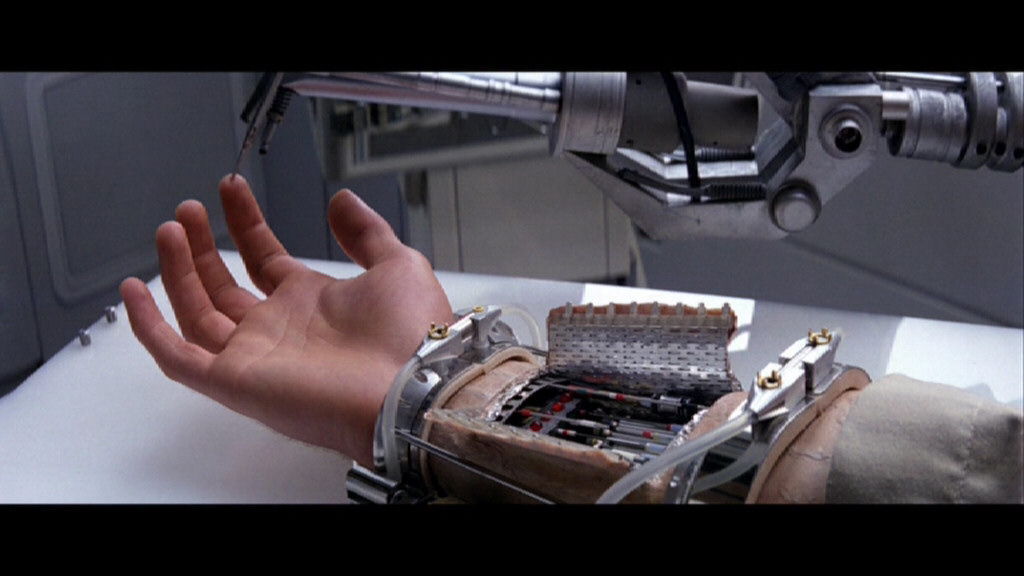
In countries with single payer health care I'd get one of these
Labels: health care
2 comments
Monday, July 16, 2007
Fighting a popular deception

Kevin Drum often makes the point that when you hear someone mention waiting time for hip replacements in Canada as an argument against single payer health care you know they're a shill. Paul Krugman today reminds us why:
On the other hand, it’s true that Americans get hip replacements faster than Canadians. But there’s a funny thing about that example, which is used constantly as an argument for the superiority of private health insurance over a government-run system: the large majority of hip replacements in the United States are paid for by, um, Medicare.
That’s right: the hip-replacement gap is actually a comparison of two government health insurance systems. American Medicare has shorter waits than Canadian Medicare (yes, that’s what they call their system) because it has more lavish funding — end of story. The alleged virtues of private insurance have nothing to do with it.
The bottom line is that the opponents of universal health care appear to have run out of honest arguments.
Labels: health care
0 comments
Tuesday, July 10, 2007
Kevin Drum gets one wrong
Kevin Drum at Political Animal is usually spot-on in his analysis. Today, though, he missed the mark by a quite a bit:
Which is fine with me. A [health care] system that works better and doesn't cost any more strikes me as a huge win for everyone. Rather than overall cost, then, which doesn't matter to most people anyway (as far as most employed people are concerned, healthcare is essentially free right now) the selling point of national healthcare is freedom from the endlessly gnawing problems of our current jury rigged system. For example: HMOs that make it hard to see a specialist. High and rising copayments. Fear of losing coverage if you lose your job. Long waits for non-urgent care. New (and usually worse) healthcare coverage every time your HR department is told to find a cheaper plan.
I guess I can't speak for most employed people, but over the past seven years, my company has been handing out 3% pay raises on average, while increasing employee health care contributions and decreasing benefits. I pay a portion of the total cost of my health insurance, which is deducted directly from my gross wages. Over the last 7 years, my share of the total cost has gone up at the same time that the total cost has been rising by 10% a year.
For many people in this company, then, the increased cost of health insurance -- to them -- has actually been greater than the wage increase.
It seems to me that there are very few, very fortunate people out there who actually get "free" health insurance any more.
Labels: health care
0 comments
Sunday, July 01, 2007
Nothing evil here
Slashdot has a note that Google is apparently using Sicko to help boost ad sales:
The New York Times calls Sicko a “cinematic indictment of the American health care system.” The film is generating significant buzz and is sure to spur a lively conversation about health coverage, care, and quality in America. While legislators, litigators, and patient groups are growing excited, others among us are growing anxious. And why wouldn’t they? Moore attacks health insurers, health providers, and pharmaceutical companies by connecting them to isolated and emotional stories of the system at its worst. Moore’s film portrays the industry as money and marketing driven, and fails to show healthcare’s interest in patient well-being and care.
If you Google Sicko you still get appropriate results. The movie trailer, the imdb site, suggestions for Michael Moore links. Plus, you get one paid link for a magazine critical of the film.
Big whoop. That's advertising, baby. I wish we didn't debate public policy in 30 second spots, but we do. There are big bucks in health care advertising dollars. Someone at Google is thinking a little outside the box.
Frankly, I hope there's a lot of anti-Sicko advertising from the big drug companies. Every 30 second ad about Sicko is one less add for boner pills.
Labels: health care, Sicko
0 comments
Wednesday, June 06, 2007
The slow march to universal healthcare
The Squid, my only friend who actually holds elected office, sent me an email yesterday:
From an opinion piece in “The Economist”
“Comprehensive health-care reform to create a system where all Americans have access to portable health insurance would do a lot to reduce workers’ anxiety and equip them for an economy that these days demand frequent job shifts.”
I’m taking this a bit out of context but the statement alone makes sense. I haven’t been big on a complete reform of our health-care system but this argument has merit. If the working class family didn’t have to worry about health care access (some sort of universal coverage) the workers may be more flexible with management and be ready to move on when necessary.
Thought of you when I read it.
I think The Squid would probably describe himself politically as a pragmatist and a moderate (unlike the wild eyed liberals that write 3WN) so I think having people like him start to consider universal healthcare is a good sign that the issue is growing in acceptance. I sent him the following response:
"That's exactly what I have been saying for a while. Universal coverage is good for workers and it is good for corporations. And of course it is good for people who are currently uninsured for one reason or another.
I have a good friend who's wife was diagnosed with cancer in the short period between when she left her job and when they got married and she was going to go on his insurance. Once she was diagnosed no company would touch her because it is a preexisting condition. That was 13 years ago and she is now fine health wise but it destroyed them financially. They are 40 and have never been able to buy a house and are still paying old bills. There's no other developed country in the world where this would happen and I think Americans should be ashamed.
That's also why I would like to see a single payer program so that the insurance pool includes everyone in the nation. Insurance companies currently make money by trying to only insure the healthiest people and spend a ton of money trying to figure out who those people are. And don't get me started on the costs to doctors and clinics of dealing with all those different companies.
I also wonder what it would do to unemployment if people not yet 65 could choose to retire without fear of being without insurance. That might actually open up a fair number of jobs to younger workers and save money for the companies as well.
As I think about it I'm not sure universal health insurance would make for more cooperative workers, tho. I bet these days workers are so scared of losing their health insurance that they will put up with a lot more from employers than they otherwise would. Maybe secure health benefits will make workers start demanding higher wages and some of the productivity gains of the last decade might actually make it to the ones doing most of the work. Universal might be one of those things that has an impact on society well beyond what anyone expects or predicts."
Labels: health care
0 comments
Wednesday, May 16, 2007
When is someone going to champion universal healthcare?
The NYT on the Chrysler/Benz crash:
I said it in one of the very first posts I ever made here at 3WN. This is a winning issue for the Democrats. Grab it now people and be a hero to ordinary workers AND American business. If you can't see how this works you don't deserve to get elected to anything.Still, those problems might have been solved. What seemed intractable was the tremendous drag of Chrysler’s legacy costs. The pension and health-care commitments for employees and retirees come to a whopping $18 billion.
This is a role reversal: it is the American free-market system that is supposed to be maneuverable like a snazzy little sports car and the German social welfare state that is supposed to groan under the weight of high costs.
Cerberus will try to lower those costs at the negotiating table with the United Automobile Workers. But policy makers in the United States will also have to confront the increasingly obvious fact that the American health-care morass does not just leave close to 50 million people without insurance, it is a drag on our most important industries.
Labels: health care, political issues
10 comments
Friday, February 09, 2007
We're number 1[69]!
Ah, good company.
A recent study from the McGill University Institute for Health and Social Policy in Montreal found that of 173 countries surveyed, 168 guaranteed women paid maternity leave. The United States – along with Lesotho, Liberia, Papua New Guinea and Swaziland – was not one of them.
66 countries offer paid leave to fathers as well. Needless to say we are not one of those either. Download the report here.
Labels: family values, health care
0 comments


